
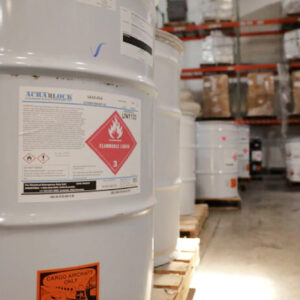
Two drums can look identical, yet one needs hazmat labels and shipping papers while the other can ride as ordinary freight. The difference often comes down to flash point, the lowest temperature at which a liquid gives off enough vapor to ignite. This article explains how the U.S. Department of Transportation separates flammable from combustible liquids, why that distinction matters, and where shippers get caught.
The basic definitions
Under 49 CFR, a flammable liquid is generally a liquid with a flash point of not more than 60 °C (140 °F). A combustible liquid has a flash point above 60 °C (140 °F) and below 93 °C (200 °F). Liquids above that range, such as many heavy lubricating oils, are not classified as either. Common flammables include gasoline, acetone, many paints, alcohol and certain adhesives. Common combustibles include some diesel fuels, kerosene-type products, certain solvents and some oils. Learn more about flammables in our Class 3 flammable liquids guide.
Why combustible status can be less restrictive
In U.S. domestic ground transportation, a combustible liquid in non-bulk packaging is generally excepted from the hazardous materials regulations, meaning no hazmat labels, placards or full shipping description are required, provided no other hazard applies. In bulk packaging, which includes containers above certain capacity thresholds, such as larger tanks and IBCs, it is regulated and must be described, marked and placarded. This is why the same product can be exempt in 55-gallon drums but regulated in a tote or tank truck.
Exceptions to the exception
The combustible liquid exception does not apply if the liquid also meets another hazard definition, such as:
- A hazardous substance reportable quantity or marine pollutant status.
- An elevated-temperature material, where the liquid is offered while hot.
- A subsidiary hazard, such as being toxic or corrosive.
Always read the full SDS rather than relying on flash point alone.
Other modes follow different logic
The combustible category is mostly a U.S. domestic concept. Under the IMDG Code for ocean shipping and the IATA regulations for air, Class 3 generally ends at a flash point of 60 °C, and the U.S. combustible category is not carried over in the same way. A product that moves freely by U.S. ground may therefore be a different case when it is exported through Port Miami or flown from MIA. If your product goes international, treat each mode independently and check marine pollutant status, which can add requirements even for non-flammable liquids. See export documentation for Port of Miami and Port Everglades.
Why flash point accuracy matters
Flash point can be affected by formulation, test method and blending. A manufacturer might list one number on the SDS, but a blended or diluted product may differ. If the flash point is near the threshold, a lab test or a written declaration from the manufacturer may be advisable. Misclassifying a flammable as combustible can lead to fines, rejected freight or an unsafe load. Our article on common hazmat regulation violations explains the stakes.
How packing groups relate
For liquids that are flammable, the packing group depends on flash point and initial boiling point. Combustible status is not a packing group. See packing groups explained for the table and examples.
Practical tips
- Collect the SDS and verify Section 9 (flash point) and Section 14 (transport).
- Ask whether the product will ever travel in bulk containers.
- Check for hazardous substance and marine pollutant status.
- If the load goes by ocean or air, classify under those regulations separately.
- When in doubt, ship as hazmat and verify; the cost of caution is usually lower than a rejected load.
Get a second opinion
Go Hazmat’s compliance team reviews SDS data and prepares the correct description, whether the cargo is a flammable, a combustible or something in between. Use our hazmat checklists to organize information and request a quote when you are ready to ship. This article is general guidance, not legal advice.
Frequently asked questions
What is the flash point difference between flammable and combustible liquids?
Under U.S. DOT rules, flammable liquids have a flash point of 60 °C (140 °F) or below, while combustible liquids are above 60 °C and below 93 °C (200 °F).
Do combustible liquids need hazmat shipping papers?
In non-bulk packaging for domestic ground transport they are generally excepted, but bulk packaging and certain other hazards bring them back into regulation.
Does the combustible liquid exception apply to air and ocean?
Generally no. IATA and IMDG classify Class 3 differently, so check the mode-specific rules before relying on the U.S. domestic exception.
Recent Comments