
Florida runs on pool season. Pool supply distributors, retailers and service companies move huge volumes of sanitizers, shock treatments and acids, and nearly all of it is regulated as hazardous material. The products are common, but the shipping rules are not forgiving, especially when oxidizers and acids end up on the same pallet.
This guide explains how the most common pool chemicals are typically classified and what to check before you ship. Always confirm classification against the product’s own Safety Data Sheet and the Hazardous Materials Table in 49 CFR 172.101, since formulations and concentrations change the answer.
The usual suspects and their typical classes
- Calcium hypochlorite (cal-hypo, “shock”): An oxidizer, Class 5.1. UN numbers depend on the form and available chlorine content, such as UN2880 for hydrated calcium hypochlorite or UN1748 for dry calcium hypochlorite above certain concentrations. Packing group is usually II or III depending on the formulation.
- Trichloroisocyanuric acid (trichlor tablets and sticks): Also an oxidizer in Class 5.1, commonly shipped under UN2468 with packing group II.
- Sodium hypochlorite solution (liquid chlorine): Typically Class 8 corrosive, often UN1791, with packing group depending on concentration.
- Hydrochloric (muriatic) acid: Class 8 corrosive, commonly UN1789.
- pH increasers and decreasers, algaecides, stabilizers: Some are non-regulated, others are corrosive or environmentally hazardous. Check each SDS.
Treat that list as a starting point. If a label says “Danger” or “Warning,” the SDS Section 14 will tell you more. Our guide to reading SDS Section 14 can help.
The segregation problem
Oxidizers like cal-hypo and trichlor can react violently when they contact acids, organics, fuels or other chemicals. That is why segregation is one of the biggest compliance and safety concerns in pool chemical logistics.
- Do not load oxidizers with acids or flammable liquids unless the segregation table says it is allowed.
- Keep chlorine products dry. Moisture and incompatible dust can cause hazardous reactions.
- Make sure damaged bags or leaking containers are removed from the load, not repacked on the dock without proper procedures.
Read more in our guide to hazmat segregation rules for ground transport and oxidizer shipping rules.
Packaging and marking
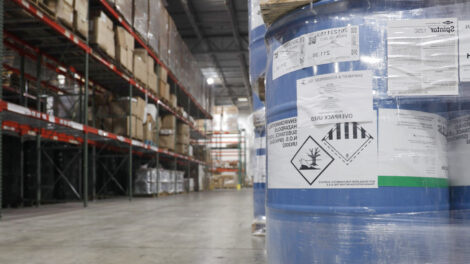
Fully regulated pool chemicals generally need UN specification packaging suited to the packing group. Many retail pool products ship in consumer-size containers, which may qualify for limited quantity or other reduced provisions when the conditions are met. Check:
- Maximum quantity per inner container and per package
- Outer packaging type and strength
- Required marks and labels, including the oxidizer or corrosive label
- Whether the shipment needs placards at the pallet or vehicle level
See our posts on UN-rated packaging and limited quantity shipping.
Heat, humidity and Florida logistics
Florida summers add real risk. Heat can accelerate decomposition in some oxidizers, and humidity can compromise packaging. Practical steps:
- Avoid leaving loaded trailers in the sun for long periods.
- Store pallets off the floor and away from water intrusion.
- Inspect packaging for swelling, odor or residue before loading.
- Use a hazmat-qualified warehouse for staging; see our hazmat warehouse storage guide.
Documentation and training
Shipping papers must include the basic description, quantity, shipper’s certification where applicable and a 24-hour emergency response number. Employees who pack, label or sign need current hazmat training. Our compliance team and training services can help.
Environmental considerations
Some pool and algae treatments are environmentally hazardous substances, and others are marine pollutants when shipped by sea. If you export to the Caribbean from Miami, review the marine pollutant guidance and Caribbean export tips.
Ship pool chemicals with confidence
GoHazmat supports South Florida pool supply businesses with classification help, compliant paperwork, repacking and transportation coordination. Request a quote to get started.
Frequently asked questions
Is pool shock considered hazardous material?
Pool shock products based on calcium hypochlorite are generally regulated as Class 5.1 oxidizers. Confirm the UN number and packing group using the product’s SDS and the Hazardous Materials Table.
Can I ship chlorine tablets and muriatic acid together?
Typically not on the same load without checking segregation requirements. Oxidizers and corrosive acids can react dangerously, and the regulations restrict loading them together in many cases.
Do pool chemicals qualify for limited quantity shipping?
Some consumer-size pool products can ship as limited quantity if they meet the quantity, packaging and marking conditions for that UN number. Others cannot, so check the specific entry.
Recent Comments