
Class 9 is the catch-all division of the dangerous goods system, and that is exactly what makes it dangerous for shippers. A material that does not fit neatly into flammables, corrosives, gases or toxics can still be fully regulated — and Class 9 is where a surprising amount of ordinary commercial freight lands: lithium batteries, dry ice, magnetized material, elevated-temperature substances, asbestos, and environmentally hazardous substances.
Because Class 9 covers such different hazards, there is no single set of rules that applies to all of it. What you actually need is the entry-specific rules tied to your UN number. This guide walks through what Class 9 covers, how it gets marked and documented, and the mistakes that most often get a Class 9 shipment rejected at a Miami air or ocean terminal.
What Class 9 actually covers
Under 49 CFR, the IATA Dangerous Goods Regulations and the IMDG Code, Class 9 is defined as “miscellaneous dangerous substances and articles” — materials that present a transport hazard but are not covered by the other eight classes. There are no divisions within Class 9, but the common commercial entries include:
- UN3480 / UN3481 — lithium ion batteries (shipped alone, packed with equipment, or contained in equipment)
- UN3090 / UN3091 — lithium metal batteries
- UN1845 — carbon dioxide, solid (dry ice)
- UN3077 — environmentally hazardous substance, solid, n.o.s.
- UN3082 — environmentally hazardous substance, liquid, n.o.s.
- UN2807 — magnetized material (air only)
- UN3257 / UN3258 — elevated temperature liquid or solid
- UN2211 / UN3314 — polymeric beads and plastics moulding compound (evolving flammable vapour)
- UN2212 / UN2590 — asbestos
- UN3268 — safety devices, electrically initiated (airbag modules, seat-belt pretensioners)
Why “Class 9” tells you almost nothing on its own
A dry ice shipment and a lithium battery shipment are both Class 9, but they share almost no operational rules. Dry ice has ventilation and quantity considerations; lithium batteries have state-of-charge limits, watt-hour marking, and passenger-aircraft prohibitions. If a carrier, packer or forwarder tells you “it’s just Class 9, it’s easy,” that is a signal to slow down. Always work from the UN number and the applicable special provisions, not the class number.
Packing groups: mostly none, sometimes III
Most Class 9 entries have no packing group assigned — lithium batteries and dry ice among them. A few do carry Packing Group III, most notably UN3077 and UN3082 environmentally hazardous substances. When a packing group is assigned, you need UN specification packaging tested to at least the PG III performance level. When none is assigned, the packaging requirements come from the specific packing instruction rather than from a performance level, which is a distinction that trips up shippers coming from a Class 3 or Class 8 background.
Marking, labelling and placarding
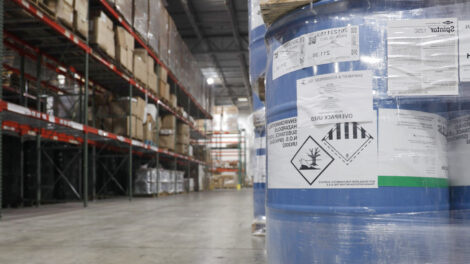
The Class 9 label is visually distinctive: seven vertical black stripes across the top half on a white background, with a black bar across the middle and the class number 9 underlined at the bottom. Since the 2022–2023 regulatory cycle there is also a separate lithium battery mark (the battery pictogram with the red hatched border) that is used for excepted lithium battery shipments — it is not interchangeable with the Class 9 hazard label, and mixing the two is one of the most common causes of a rejected battery shipment.
For highway transport, Class 9 placarding is not required domestically in the United States for most shipments, though it is required internationally and many carriers request it anyway. If your freight is moving on a through bill to a vessel or an aircraft, plan for the international rule, not the domestic exemption.
Documentation: where Class 9 shipments actually fail
In our experience preparing declarations at the hazmat compliance desk, Class 9 rejections cluster around a handful of documentation errors:
- Missing the technical name in parentheses. UN3077 and UN3082 are “n.o.s.” entries and require the technical name of the substance after the proper shipping name.
- Omitting “MARINE POLLUTANT” for ocean moves. Under the IMDG Code the notation belongs on the transport document when applicable.
- Wrong lithium battery packing instruction. PI 965 through 970 are not interchangeable, and Section IA, IB and II have different documentation triggers.
- No net quantity of dry ice per package. Air waybills for UN1845 need the net weight of dry ice in each package, not just the total.
- Elevated temperature material shipped without the correct mark. The red triangular mark is separate from the Class 9 label.
Practical handling considerations
Class 9 freight often needs conditions the paperwork never mentions. Dry ice sublimates, so a delay in a sealed container becomes an asphyxiation hazard for the next person to open the door. Lithium batteries need to be protected against short circuit and movement inside the package. Environmentally hazardous substances need secondary containment if there is any chance of a leak reaching a drain.
If your Class 9 freight is staging in South Florida before an export sailing or flight, storage conditions matter as much as the declaration. Our hazmat warehousing operation in Miami keeps segregated, monitored space for regulated materials rather than mixing them into general cargo racking, and our team can repack or re-mark non-compliant freight before it reaches a terminal that will reject it.
A short pre-shipment checklist for Class 9
- Confirm the exact UN number and proper shipping name from Section 14 of the SDS, then verify it against the current regulation for your mode
- Check whether a packing group applies, and whether UN specification packaging is required
- Confirm which label applies — Class 9 hazard label, lithium battery mark, or both
- Add technical names, marine pollutant notation and net quantities to the transport document
- Verify the carrier accepts that entry on that aircraft or vessel type
- Check that your hazmat employees have current, function-specific training for the entry you are shipping
If you are unsure whether your material is Class 9 at all, that is worth resolving before the freight is packed. A hazmat consultation takes far less time than unpacking a rejected pallet at a cargo terminal.
Frequently asked questions
Is Class 9 considered less dangerous than other hazard classes?
No. Class 9 is a residual category, not a low-severity one. Lithium battery fires and elevated-temperature materials are among the more serious transport hazards in commercial freight. The class number describes what the material is not, not how hazardous it is.
Do I need placards for a Class 9 shipment by truck in the United States?
Domestic highway shipments in the U.S. generally do not require Class 9 placards, but international shipments do, and many carriers require them by policy. If the load is going to a port or airport for export, plan on placarding.
Can Class 9 materials be shipped as limited quantity?
Some can. Certain Class 9 entries — including UN3077 and UN3082 — have limited quantity provisions, and some lithium battery shipments move under excepted provisions with the lithium battery mark. Eligibility depends on the specific UN number, the quantity per inner packaging, and the mode of transport, so check the entry rather than assuming.
Recent Comments