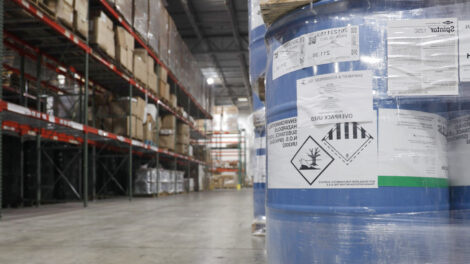
Plenty of warehouses in South Florida will say yes to a pallet of chemicals. Far fewer are actually built, permitted, and staffed to store hazardous materials legally and safely. If you are a manufacturer, importer, or forwarder looking for dangerous goods storage near PortMiami, Port Everglades, or MIA, this guide covers what a compliant hazmat warehouse must do — and the questions that separate real DG facilities from general warehouses taking risks with your inventory.
Segregation of incompatible hazard classes
The foundation of chemical warehousing is keeping incompatible materials apart. Oxidizers stored next to flammables, acids near cyanide-containing products, corrosives dripping onto reactive metals — these combinations turn a small leak into an emergency. A proper facility:
- Maintains a written segregation scheme based on hazard class and the specific chemistry of what is stored, not just the label color
- Physically separates incompatible classes with distance, dedicated rooms or bays, or approved barriers — not just different rack levels
- Controls putaway through the WMS so a receiving clerk cannot accidentally slot a Class 5.1 oxidizer into a flammables bay
- Applies transport segregation logic (the 49 CFR and IMDG segregation tables) when staging freight for outbound loads, since a legal storage arrangement can still be an illegal trailer
Ask any prospective 3PL to show you their segregation map and explain how the system enforces it.
Ventilation and temperature control
Many stored hazmat products emit vapors, and some degrade or become unstable with heat. In Miami, where ambient temperatures sit above 90°F with high humidity much of the year, this is not a theoretical concern:
- Ventilation must be adequate to prevent vapor accumulation in storage areas, with particular attention to flammable liquid rooms and anywhere aerosols are stored in quantity.
- Temperature control matters for products with maximum storage temperatures on their SDS — certain resins, adhesives, peroxide-containing formulations, and pharmaceuticals. Un-conditioned Florida warehouse air can exceed label limits for weeks at a time in summer.
- Humidity attacks fiberboard packaging, corrodes drums and steel racking, and can compromise water-reactive materials. Climate control protects the packaging integrity your transport compliance depends on.
Go Hazmat’s secure, temperature-controlled hazmat warehousing in Miami was designed around exactly these South Florida conditions.
Secondary containment and spill response
When — not if — a container leaks, the facility’s containment determines whether it is a mop-up or a reportable release:
- Spill pallets, bermed floors, or containment sumps sized for the stored volumes, so a leaking drum cannot reach drains or neighboring product
- Segregated containment per compatibility group, so a spill does not mix incompatible chemicals in the same sump
- Stocked spill response equipment matched to the inventory, with staff trained on when to respond and when to evacuate and call in specialists
- Documented inspection routines that catch weeping drums and swollen containers before they fail
Fire code and NFPA considerations
Hazardous materials storage in Florida is governed by the Florida Fire Prevention Code and local enforcement by Miami-Dade fire officials, which draw heavily on NFPA standards — including those covering flammable and combustible liquids, hazardous materials storage generally, and aerosol products. Without diving into edition-specific numbers, expect a legitimate facility to have:
- Permits reflecting the types and quantities of hazardous materials stored, with maximum allowable quantities established for each area
- Sprinkler protection designed for the commodities actually stored — high-piled flammable liquids and aerosols require far more than an ordinary storage system
- Approved flammable liquid storage rooms or cabinets where quantities require them
- A hazardous materials inventory available to the fire department, and a current emergency response plan
If a warehouse cannot tell you its permitted quantities by hazard category, it does not really know whether your inventory is legal to store there.
Security: TSA, C-TPAT, and chain of custody
Dangerous goods storage carries security obligations beyond ordinary theft prevention. DOT security plan requirements apply to facilities handling certain hazardous materials, and freight touching the air and ocean supply chains brings TSA and CBP expectations with it. Look for controlled access, camera coverage, visitor management, background-checked and TSA-approved staff for air-cargo-connected freight, and documented chain of custody from receipt to outbound tender. Facilities aligned with C-TPAT-style supply chain security practices make your own customs and carrier relationships easier.
The Miami-Dade factors: hurricanes, heat, and ports
Storing hazmat in South Florida adds considerations that a Midwest checklist never mentions:
- Hurricane preparedness. A DG warehouse needs a written hurricane plan: securing or relocating vulnerable inventory, protecting containment systems from wind-driven rain and flooding, generator capacity for temperature-controlled areas, and a communication plan so customers know the status of their product before and after a storm.
- Flood zone reality. Ground-level storage of water-reactive or environmentally hazardous materials in a flood-prone location is a liability. Elevation and drainage matter.
- Port and airport proximity. The economics of DG storage here are tied to drayage. A facility near PortMiami and Port Everglades lets you transload, repack non-compliant cargo, and hit earlier DG gate cutoffs without long, placarded highway legs across the county.
What to ask a hazmat 3PL before you sign
- Which hazard classes and UN numbers can you legally store, and in what quantities?
- Show me your segregation scheme and how the WMS enforces it.
- What fire protection is in place, and what do your permits actually cover?
- How is secondary containment sized and segregated?
- Who on staff is hazmat-trained, and how current is the training?
- What is your hurricane plan, and when did you last run it?
- Can you handle the outbound side — compliant DG paperwork, placarded drayage, LTL and FTL — or does my freight leave your control at the dock?
Go Hazmat operates its hazmat warehouse at 3300 NW 110th St. in Miami with DGAC and COSTHA affiliations and trained staff on every shift — reach out through our contact page if you want to walk the facility.
Frequently asked questions
Can any warehouse store hazardous materials?
No. Hazardous materials storage requires appropriate fire department permits, fire protection designed for the commodities stored, segregation of incompatible classes, secondary containment, security measures, and trained staff. A general warehouse accepting DG freight without these puts your inventory — and your company’s liability exposure — at real risk, since regulators and insurers look to the cargo owner as well as the facility.
Does hazmat stored in a warehouse still fall under DOT regulations?
Storage incidental to transportation — for example, freight held at a 3PL between transport legs — remains subject to the DOT Hazardous Materials Regulations, including security plan and training requirements. Longer-term storage shifts primarily to OSHA, EPA, and fire code jurisdiction. A competent DG warehouse manages both frameworks and knows which applies to each pallet.
What should hazmat storage near the Port of Miami include?
Beyond core compliance — segregation, containment, fire permits, trained staff — look for temperature and humidity control suited to South Florida heat, a tested hurricane preparedness plan, security aligned with TSA and C-TPAT expectations, and short-haul drayage capability to PortMiami and Port Everglades so cargo can be transloaded, repacked, and gated in before DG cutoffs.