


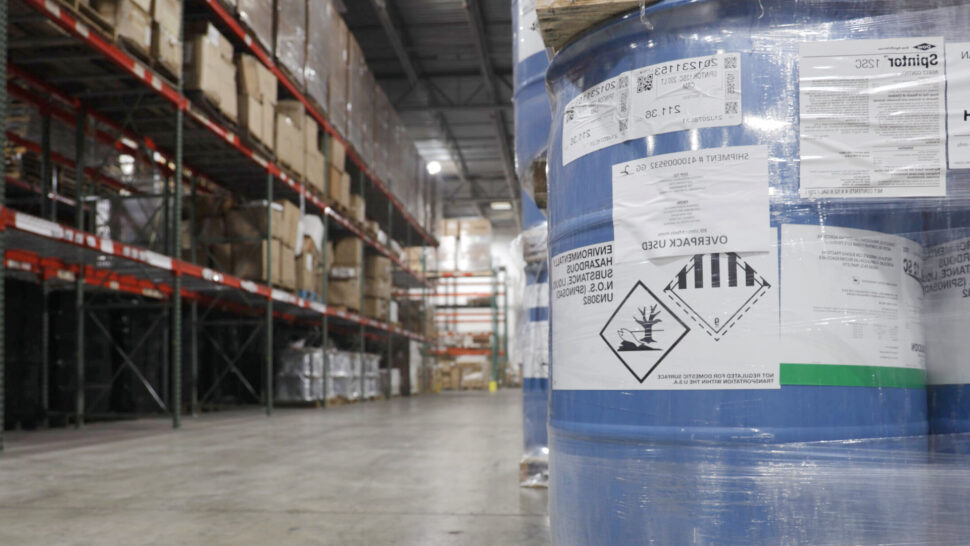
Two shipments can carry the same UN number and hazard class yet face completely different rules — because one is Packing Group I and the other is Packing Group III. The packing group is the regulations’ way of grading danger within a hazard class, and it quietly controls your packaging spec, quantity limits, mode options, and price. Here’s what the Roman numerals actually mean and everything they touch. (For the packaging codes themselves — the “4G/Y1.4/S/…” string — see our companion guide to UN specification packaging codes.)
What packing groups mean
Packing Group I indicates great danger, II medium danger, III minor danger — always relative to other materials in the same class. The criteria differ by class: for flammable liquids it’s flash point and boiling point; for corrosives, the speed of skin destruction; for toxics, lethal dose thresholds. The assignment isn’t a judgment call; it comes from test data applied to the criteria in the regulations, and it’s printed in column 5 of the 49 CFR 172.101 hazmat table entry (or the IATA/IMDG equivalents).
A few classes don’t use packing groups at all — gases, lithium batteries under their Class 9 entries, and most articles among them. If your entry shows no PG, other mechanisms (like packing instructions) do the equivalent work.
What the packing group changes
Packaging performance. UN spec packaging is certified to a level: X-marked packaging passes tests for PG I, II, and III; Y covers II and III; Z covers III only. Ship a PG II liquid in Z-rated packaging and the packaging itself is a violation, even if nothing leaks.
Quantity limits. Per-package caps by air shrink dramatically as PG rises toward I; some PG I materials are passenger-aircraft-forbidden entirely. Limited quantity relief, where available, generally excludes PG I.
Mode and carrier acceptance. Many carriers restrict PG I commodities or price them punitively. Ocean stowage categories and ground segregation notes can also tighten with packing group.
Cost. Higher-performance packaging costs more, quantity caps force more packages, and the carrier pool narrows — the PG cascades straight into your freight bill, which is one reason verifying it is worth real money. Our compliance service regularly finds SKUs shipping at a more severe PG than their data supports.
How to find and verify your packing group
Start with the SDS Section 14, then verify against the current hazmat table for your mode. For n.o.s. entries, the PG follows your product’s actual test data, not the worst case in the family. Two traps: suppliers who copy an old PG forward through reformulations, and mixtures whose components suggest one PG while the blend tests to another. When the data is ambiguous, get it resolved before you build packaging spec around a guess — a consultation is cheaper than re-drumming a warehouse of product.
Once verified, bake the PG into your item master so every BOL, declaration, and packaging purchase inherits the right value automatically.
Frequently asked questions
What does PG II mean on a shipping paper?
Packing Group II means the material presents medium danger within its hazard class and must move in packaging certified to at least the Y (PG II) performance level, with the quantity limits the regulations set for PG II in that mode.
Can packaging rated for PG I carry PG III materials?
Yes. X-rated packaging covers all three packing groups, so it can lawfully carry PG I, II, or III materials. The reverse is not true — never put a more dangerous material in lower-rated packaging.
Do all dangerous goods have a packing group?
No. Gases, lithium batteries, and most articles have no packing group; their entries rely on packing instructions and special provisions instead. An absent PG doesn’t mean relaxed rules.