


A single trailer can legally carry an astonishing mix of dangerous goods — but not every mix. The segregation table in 49 CFR 177.848 decides which hazard classes may ride together on a highway vehicle, and it’s one of the most misread charts in the hazmat regulations. Get it wrong and you’re gambling with chemical reactions in a moving trailer; get flagged for it at a roadside inspection and the load stops there.
This is a practical walkthrough of how ground segregation works, aimed at shippers who tender mixed freight and the warehouse teams who build the pallets. (Ocean stowage follows the IMDG Code’s separate, stricter scheme, which we covered in our IMDG segregation guide.)
How the 177.848 table works
The table cross-references hazard classes on each axis. At each intersection you’ll find either a blank (no restriction from the table itself), an “X” (may not be loaded, transported, or stored together), an “O” (may not be loaded together unless separated so that commingling can’t occur in a leak), or a “*” pointing to special rules for Class 1 explosives.
Three things trip people up. First, the table applies to the materials’ primary AND subsidiary hazards — a corrosive liquid with a 5.1 subsidiary must be checked both ways. Second, “loaded together” includes temporary storage in transit, so cross-dock staging counts. Third, the table is a floor, not a ceiling: packages that pass the chart can still be a bad idea together if the SDS shows specific incompatibility.
The pairings that cause the most trouble
In everyday freight, the combinations that most often produce an X or O are Class 8 corrosives against Class 4 and 5 materials, Class 5.1 oxidizers against Class 3 flammables, and anything against Division 6.1 PG I toxics. Class 1 explosives and Class 7 radioactive materials have their own tightly restricted matrices that most commercial shippers rarely touch.
Notice what’s NOT restricted: many Class 3 and Class 8 pairings, most Class 9 combinations, and limited quantity shipments — Ltd Qty packages are largely exempt from the table. That relief is one more reason to check whether your product legitimately qualifies for limited quantity treatment.
Segregation starts at the warehouse
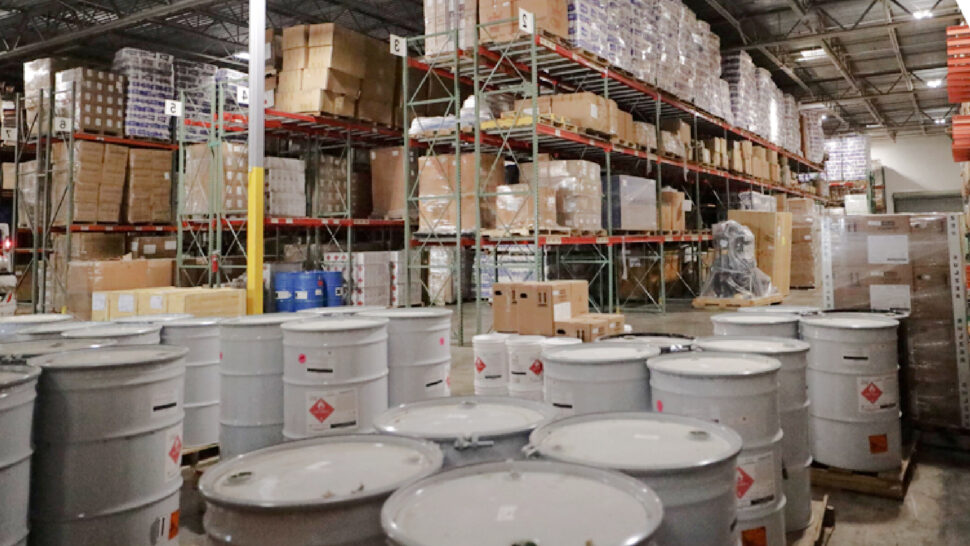
By the time a trailer is loading, segregation should already be solved. That means storage racking that separates incompatible classes, pick-and-pack processes that don’t stage acids next to oxidizers, and load plans written before the forklift moves. Go Hazmat’s Miami warehouse is laid out around exactly this — dedicated hazmat zones with class-based separation, so freight leaves the dock in a compliant configuration.
For LTL shipments the stakes are different but real: your pallet will share a trailer with strangers’ freight, and the carrier’s ability to accept it depends on accurate classification on your bill of lading. Our LTL hazmat service pre-checks segregation compatibility before tender so the pallet doesn’t bounce at the terminal.
A simple pre-load checklist
Before any mixed hazmat load leaves your dock: confirm every item’s class, division, and subsidiary risk from its shipping description; run every pair through the 177.848 table; verify O-rated pairs are physically separated with no commingling path; confirm placarding for the aggregate load; and document the load plan. Five minutes of checking beats a roadside out-of-service order every time.
If your team builds mixed loads regularly and nobody has been through segregation training recently, that’s a gap — DOT requires function-specific training for exactly this task, and Go Hazmat’s training programs include hands-on load-planning modules.
Frequently asked questions
What does the “X” mean in the hazmat segregation table?
An X at the intersection of two hazard classes means those materials may not be loaded, transported, or stored together on the same transport vehicle. There is no packaging workaround — they must move separately.
Do limited quantity packages have to follow the segregation table?
Limited quantity packages are generally excepted from the 177.848 segregation requirements by ground, which is one of the practical benefits of qualifying for Ltd Qty treatment. Ocean and air rules differ.
Does the segregation table apply to subsidiary hazards?
Yes. You must check the table against both the primary class and any subsidiary hazard shown in the shipping description. A material with a 6.1 subsidiary is checked as if it were also a 6.1.