


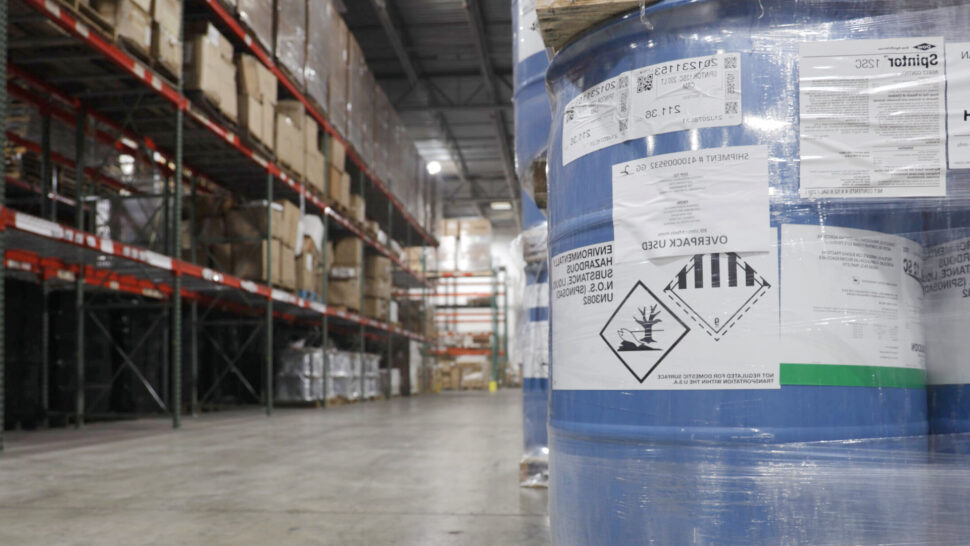
Package markings and labels are the details that get a hazmat shipment through the door — or turned away at the dock. They’re also the piece of compliance most often confused with vehicle placarding, a separate requirement covering the outside of a vehicle rather than the package. This guide covers what has to appear on the box, drum, or overpack, how legible it needs to be, and the marking errors that most often cause rejected freight at MIA cargo and PortMiami. These requirements change between editions of 49 CFR, the IATA Dangerous Goods Regulations, and the IMDG Code, so confirm current requirements against the edition in effect for your shipment.
Markings vs. labels vs. placards
These three terms get used interchangeably, and that’s usually where trouble starts.
- Markings are printed text and symbols on the package — proper shipping name, UN identification number, consignor/consignee information, UN specification packaging codes, and special marks like limited quantity or marine pollutant marks.
- Labels are the diamond-shaped hazard class and subsidiary risk labels on the package, plus handling labels such as orientation arrows and lithium battery marks.
- Placards are the larger diamonds required on the exterior of trucks, rail cars, and freight containers once quantity thresholds are met — see our DOT hazmat placarding requirements guide for that separate, vehicle-level rule set.
A package can be marked and labeled correctly and the shipment can still need placards on the truck — the two systems are governed by different sections of 49 CFR Part 172.
Required package markings
Proper shipping name and UN identification number
Every non-excepted hazmat package must be marked with the proper shipping name and UN or NA identification number as they appear in the Hazardous Materials Table (49 CFR 172.101) or the applicable IATA/IMDG dangerous goods list. Technical names in parentheses are required for certain “n.o.s.” entries, and abbreviations generally aren’t allowed. The name must match the shipping paper word-for-word — a mismatch is one of the fastest ways to trigger a hold.
UN specification packaging certification marking
Packagings that have passed UN performance testing carry a certification code (for example, “UN 1A2/Y1.4/150/23/USA/M1234”) identifying the packaging type, performance level, gross mass or specific gravity, test year, and approval agency. It has to match the packing group and specific gravity of the actual contents — a drum rated below requirement fails compliance even with a correct label. Our breakdown of UN specification packaging codes explains how to decode these markings.
Orientation arrows
Liquid hazardous materials in single or combination packagings without inner packagings capable of maintaining their attitude must display orientation arrows on two opposite vertical sides. Missing or reversed arrows routinely cause leakage claims and rejected freight, especially with combination packagings shipped by air.
Limited quantity and excepted quantity marks
Materials shipped under limited quantity or excepted quantity provisions use distinct marks instead of full hazard class labels in most cases. The two marks are visually different, tied to different regulatory relief, and not interchangeable. Using a limited quantity mark on a shipment that no longer qualifies once thresholds are exceeded is a common mismatch — see our comparison of limited quantity vs. excepted quantity shipping for the qualifying criteria.
Marine pollutant mark
Materials meeting the marine pollutant criteria, including many UN3077 and UN3082 entries, require the marine pollutant mark on packages moving by vessel, and sometimes by other modes connecting to one, in addition to any hazard class label required. This mark is one of the most commonly missed on freight staged for PortMiami or Port Everglades.
Overpack marking
When packages are consolidated into an overpack, the word “OVERPACK” must appear outside if inner markings aren’t visible, and hazard labels on the inner packages must be reproduced on the overpack unless every inner marking shows through. An overpack marked “OVERPACK” but missing a reproduced label underneath is incomplete, not a shortcut.
Lithium battery marks
Lithium metal and ion batteries and cells — standalone, packed with equipment, or contained in equipment — require the lithium battery mark showing the applicable UN number(s) and a phone number. Class 9 labels may also apply depending on the entry, quantity, and configuration. These shipments are among the most frequently mis-marked freight moving through MIA cargo, largely because requirements have shifted across recent IATA DGR editions.
Hazard class labels and subsidiary risk labels
Primary hazard class labels are the diamond symbols for Class 1 through Class 9. Materials with more than one hazard also require subsidiary risk labels, without the class number in the bottom corner. Multiple labels must sit near each other, not scattered across faces, and each must match the current regulatory size and color spec — printing from an outdated template is a real, recurring problem.
Durability, legibility, and placement rules
| Requirement | In practice |
|---|---|
| Durability | Survives humidity and temperature swings common in South Florida warehousing and tarmac staging. |
| Legibility | Printed in English (plus other languages as required); faded or low-contrast printing doesn’t meet the standard. |
| Contrast | Contrasts with the package’s background surface. |
| Placement | Not obscured by other markings, straps, or overpack material. |
| Orientation | Labels affixed at an angle (diamond orientation) unless package shape prevents it. |
Common marking mistakes that get freight rejected at MIA and PortMiami
- Proper shipping name doesn’t match the shipping paper word-for-word.
- UN specification code doesn’t support the packing group or specific gravity of the contents.
- Old-edition label artwork, or orientation arrows missing on liquid combination packagings.
- Limited quantity mark used on a shipment that no longer qualifies at the offered quantity.
- Marine pollutant mark omitted on qualifying UN3077/UN3082 entries moving toward a vessel.
- Overpack marked but hazard labels from inner packages not reproduced outside.
- Lithium battery mark missing the required phone number, or labels obscured by wrap or strapping.
Any one of these can get a shipment held at MIA cargo or PortMiami and Port Everglades, turning a routine pickup into a missed cutoff. A pre-shipment check built around your commodities catches most of these before freight leaves the dock. If markings are inconsistent across shipments, that’s usually a process issue rather than a one-off mistake, and worth reviewing before it recurs.
Frequently asked questions
What’s the difference between a hazmat label and a hazmat placard?
A label is affixed to the individual package and communicates the hazard class of that package’s contents. A placard is a larger diamond on the exterior of the transport vehicle or freight container, required once quantity thresholds are met, regardless of how packages inside are labeled.
Do limited quantity shipments need full hazard class labels?
Generally no. Materials qualifying for the limited quantity exception use the limited quantity mark instead of the full diamond label in most cases, though the shipment still must meet all other applicable marking, packaging, and documentation requirements for that quantity level.
Why do lithium battery shipments get held so often at MIA cargo?
Lithium battery marking requirements have changed across recent IATA DGR editions, and the correct mark depends on whether the batteries are standalone, packed with equipment, or installed in equipment. Outdated marks or the wrong UN number for the configuration are a frequent cause of holds.