


Miami International Airport is one of the largest cargo gateways in the United States and the dominant air freight link between North America and Latin America and the Caribbean. That makes MIA the natural routing for South Florida dangerous goods exports — and it also means the dangerous goods acceptance process at MIA is busy, procedural and unforgiving of paperwork errors.
This guide covers what actually happens between your dock and the aircraft, and what to prepare so your freight is not the one sitting in the corner of the warehouse.
The chain of custody at MIA
A typical hazmat air export moves through more hands than shippers expect:
- Shipper classifies, packs, marks, labels and completes the Shipper’s Declaration for Dangerous Goods
- Trucker moves the freight to a cargo building on the MIA perimeter — often under TSA-approved security procedures if the freight is already screened
- Freight forwarder or IAC (Indirect Air Carrier) receives, verifies and consolidates
- Ground handler or airline cargo terminal performs the dangerous goods acceptance check
- Airline loads to the specific aircraft, subject to loading and segregation rules
The acceptance check at step 4 is a formal, documented procedure using an acceptance checklist. It is not a rubber stamp. If any item fails, the shipment is refused and returned — and by then you have paid for trucking, handling, and often a missed flight.
What the acceptance check looks at
- Declaration accuracy — UN number, proper shipping name, class and subsidiary risk, packing group, packing instruction, quantity per package, number of packages, aircraft type (passenger and cargo, or cargo aircraft only)
- Signature and certification — signed by a person, with the correct wording, and the emergency contact number present
- Package condition — no leaks, damage, staining or odour; correct outer packaging type
- Marks and labels — correct hazard labels, handling labels, UN specification marking where required, orientation arrows, overpack marking where applicable
- State and operator variations — the DGR variations for the airline and for the destination country
- Quantity limits — per package and per aircraft, and whether the entry is forbidden on the intended aircraft type
- Air waybill — dangerous goods handling information in the correct field
The variation problem
State and operator variations are the item most South Florida shippers underestimate. Two airlines flying the same route out of MIA can have materially different acceptance rules, and destination countries in the region often add their own. A shipment that flew last month on one carrier may be refused this month on another. Check the variations for the actual operating carrier and the actual destination before booking, not after.
Security screening interacts with dangerous goods
Air cargo in the United States must be screened, and screening happens either at a Certified Cargo Screening Facility or at the airline. For dangerous goods this creates a practical constraint: some screening methods are unsuitable for certain packages, and opening a correctly sealed DG package to screen it can compromise the packaging.
Working with a partner that is TSA-approved and can maintain chain of custody from your dock through tender avoids the scenario where freight arrives at MIA, cannot be screened in place, and has to be repacked. Go Hazmat’s team is TSA-approved and hazmat certified, which is why we handle both the screening chain and the DG documentation as one workflow rather than two.
Preparing freight so it clears the first time
Before packing
- Confirm the entry is permitted by air and on the intended aircraft type
- Verify the packing instruction and inner packaging limits for that entry
- Check whether a relief provision applies — limited quantity, excepted quantity, or ID8000 consumer commodity for eligible retail-format goods
- Confirm the destination country accepts the material without additional permits
At packing
- Use UN specification packaging appropriate to the packing group, with closures torqued per the manufacturer’s instructions
- Apply absorbent and cushioning suited to the material
- Mark and label before the freight leaves the packing bench, not at the dock
- Photograph the finished package and its markings
At documentation
- Prepare the Shipper’s Declaration on the correct form with the red hatched border
- Ensure the emergency number is monitored 24 hours and the responder can access the SDS
- Provide the air waybill with correct DG handling information
- Keep copies — you will need them if there is a query at the terminal
If your volumes are irregular or your team is small, having declarations prepared on site by a DG-trained specialist removes the most common failure point. That is what our mobile hazmat documentation service does across Miami-Dade and Broward: a certified specialist comes to your facility, reviews the freight against the declaration, and corrects issues before the truck leaves.
Timing: build in a buffer
Dangerous goods cutoffs at MIA are earlier than general cargo cutoffs, sometimes substantially so, because the acceptance check takes time and cannot be rushed at the aircraft. Treat the DG cutoff as the real deadline and work backwards from it. If you are running against a cutoff and cannot risk a rejection, our expedited hazmat freight service and proximity to the airport give you a shorter recovery window than most inland shippers have.
Local advantage: being close to the gateway
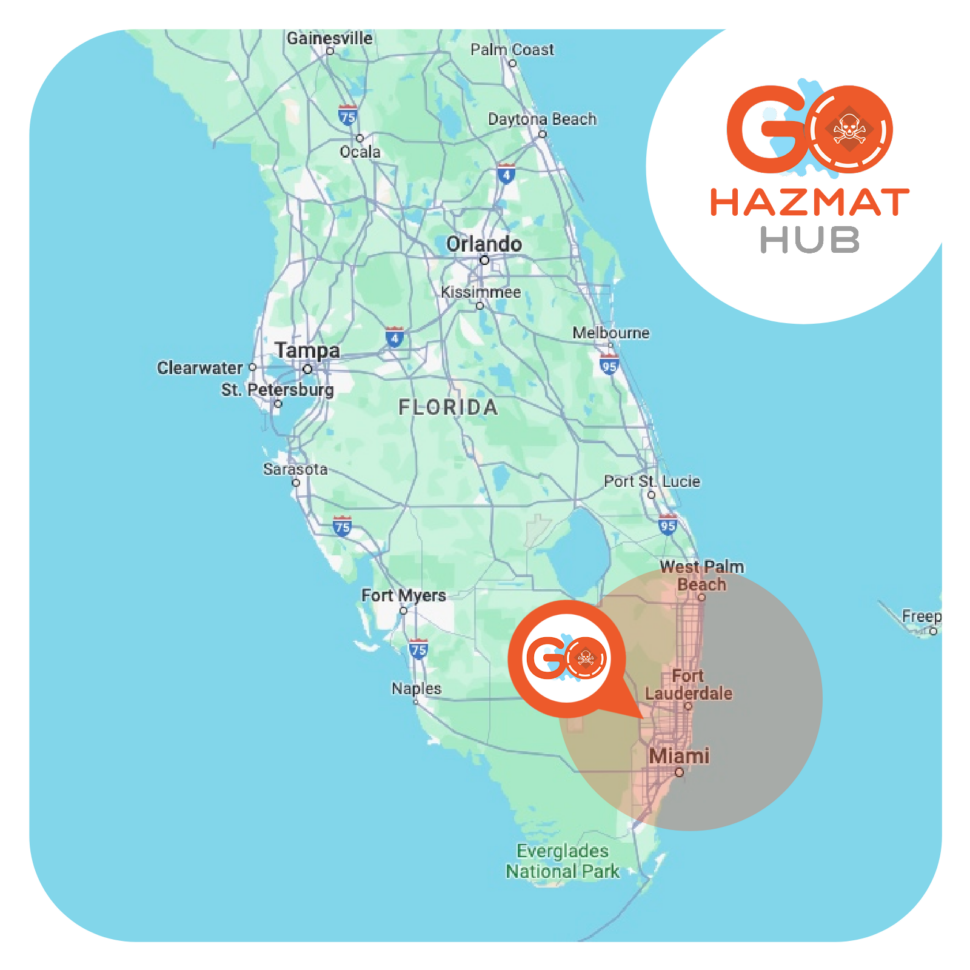
The practical benefit of staging hazmat freight in Miami rather than shipping it in from elsewhere is recovery time. When a declaration needs correcting or a package needs re-marking, the difference between a facility twenty minutes from the cargo buildings and one two states away is the difference between catching the same-day flight and missing the week. Our facility at 3300 NW 110th Street sits inside that radius, with hazmat repacking capability on site.
Frequently asked questions
Why was my dangerous goods shipment refused at the MIA cargo terminal?
The most common causes are errors on the Shipper’s Declaration (wrong packing instruction, missing subsidiary risk, wrong aircraft type), missing or incorrect labels and marks, package condition issues, and operator or state variations that prohibit the entry on that carrier or route. The acceptance checklist is documented, so ask for the specific failed item — it tells you exactly what to fix.
How early do I need to deliver dangerous goods to MIA?
Dangerous goods cutoffs are earlier than general cargo cutoffs because the acceptance check must be completed before loading. Cutoffs vary by airline and flight, so confirm the DG cutoff for your specific booking and add buffer for the possibility of a correction.
Do I need a TSA-approved trucker for air cargo out of Miami?
If the freight is to remain within the secure chain of custody as screened cargo, the driver and carrier must operate under an approved security program with the required training and background checks. Using a non-approved trucker can force rescreening at the airline, which adds cost and time and can be problematic for sealed dangerous goods packages.