


A placarded truck cannot simply take the fastest route. Federal, state and local authorities all have power to designate, prefer or restrict routes for hazardous materials, and the resulting patchwork is one of the few areas of hazmat compliance where the rules are genuinely local — and where a routing decision that was legal last year can be illegal this year.
For carriers and shippers moving dangerous goods through Florida, particularly in and out of the Miami-Dade and Broward port and airport complexes, here is how the routing framework actually works and how to verify it for a specific lane.
The federal framework: 49 CFR Part 397
Part 397 sets the baseline rules for driving and parking vehicles that contain hazardous materials. Two concepts matter most:
Preferred routes
For highway route-controlled quantities of Class 7 radioactive material, carriers must use preferred routes — Interstate System highways, routes designated by a state routing agency, or the shortest practicable route to and from those highways. This is the most prescriptive part of the framework, and it applies to a narrow category of shipments.
Operational restrictions for all placarded loads
Regardless of commodity, Part 397 imposes requirements that apply to every placarded vehicle:
- Tunnels, bridges and overpasses — the driver must avoid, so far as practicable, heavily populated areas, places where crowds are assembled, tunnels, narrow streets and alleys, unless there is no practicable alternative
- Attendance and parking — restrictions on where a placarded vehicle may be parked and for how long it may be left unattended, with tighter rules for Division 1.1, 1.2 and 1.3 explosives
- Route plan for explosives — Division 1.1, 1.2 and 1.3 shipments require a written route plan carried in the vehicle
- Fires and smoking — no smoking near the vehicle, restrictions on refuelling with the engine running
State and local designations: where it gets specific
States, and in some cases local governments, may designate or restrict routes for non-radioactive hazardous materials, subject to federal standards and a public process. When they do, those designations are submitted to FMCSA and published in the National Hazardous Materials Route Registry (NHMRR).
The NHMRR is the authoritative starting point for checking whether a designation exists in a given state. It is organised by state and lists designated and restricted routes along with the responsible agency.
Checking a Florida lane
For a specific Florida route, work through these sources in order:
- FMCSA’s National Hazardous Materials Route Registry — check the Florida entries for designated and restricted routes
- Florida Department of Transportation — FDOT publishes roadway restriction information by district, which also captures temporary restrictions from construction and incidents
- Local ordinances — municipalities and counties may restrict commercial or hazmat traffic on specific streets; Miami-Dade in particular enforces truck routing on local roads
- Facility rules — PortMiami, Port Everglades and the MIA cargo area each have their own access and routing procedures for hazmat, independent of any highway designation
- Bridge and tunnel operators — where a tunnel or major structure is on your route, confirm its hazmat policy directly with the operating agency
We deliberately do not publish a static list of Florida hazmat route bans, because such lists go stale and a driver relying on an outdated list is worse off than one who checks. Verify against the NHMRR and FDOT for the current period, every time a lane is new or a route changes.
Practical routing discipline for carriers
- Use hazmat-aware routing software. Consumer navigation apps do not model placarded-vehicle restrictions. Commercial truck routing products with hazmat profiles do, but they still need to be set to the correct hazard class for the load.
- Set the class, not just “hazmat.” Routing restrictions frequently differ by class — an explosives restriction is not the same as a general hazmat restriction.
- Plan fuel and rest stops in advance. Parking rules for placarded vehicles are stricter than for general freight, and a driver improvising a rest stop is a common source of violations.
- Document the route decision. If there was no practicable alternative to a restricted segment, being able to show the analysis matters in an enforcement conversation.
- Brief drivers on the specific load. Function-specific training under 49 CFR 172 Subpart H covers this; a generic annual session usually does not.
Why South Florida geography makes this harder
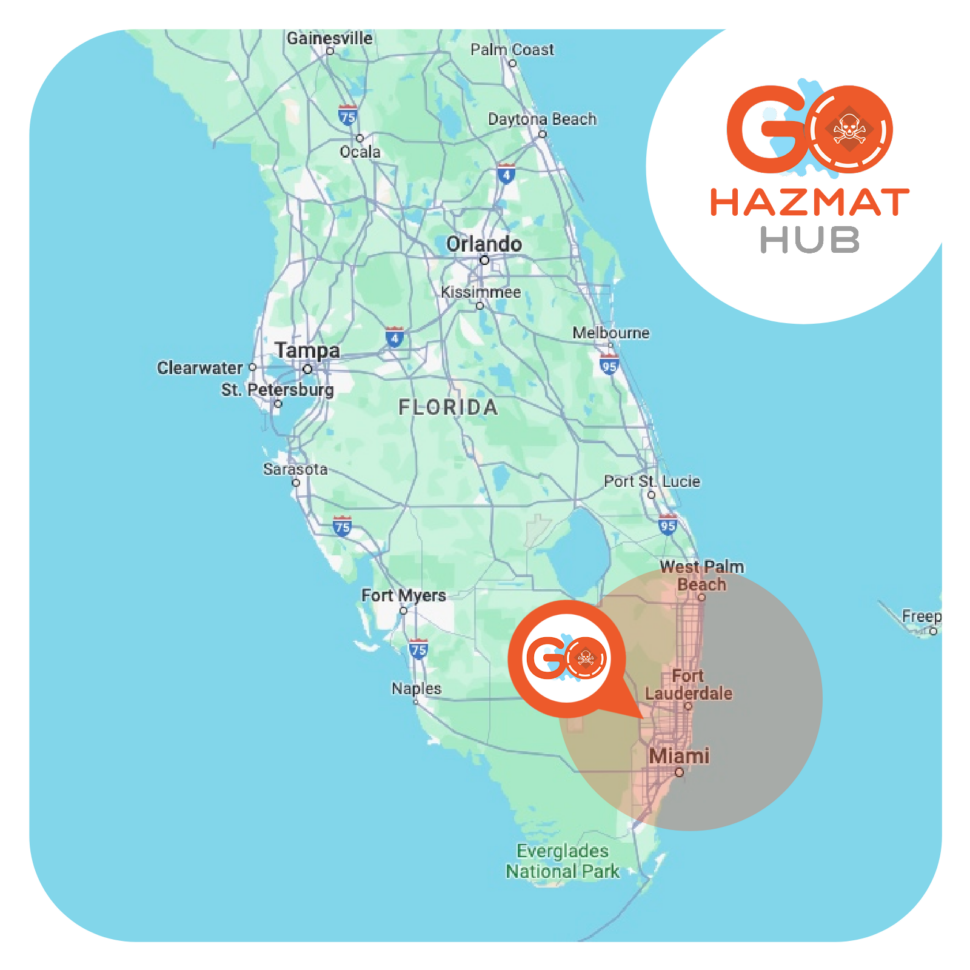
The Miami-Dade and Broward freight network concentrates hazmat movements into a small number of corridors linking the ports, MIA, and the warehouse districts inland. Add causeways, a tunnel, dense residential zones adjacent to industrial areas, and seasonal congestion, and the “practicable alternative” test in Part 397 becomes a real operational question rather than a theoretical one.
The practical answer for most shippers is to work with carriers who run these lanes daily and hold current hazmat credentials, rather than with whoever quotes lowest. Our hazmat carrier network is vetted for endorsements, registration and insurance, and our full truckload and LTL hazmat operations run the port and airport corridors continuously.
A pre-dispatch routing checklist
- Confirm hazard class, division and placarding requirement for the load
- Check the NHMRR for state designations on the intended route
- Check FDOT roadway restrictions for current closures and limits
- Verify any tunnel, bridge or causeway policy on the route
- Confirm facility access procedures at origin and destination
- Plan compliant parking and fuel stops
- Verify driver endorsement, training currency and required documents on board — including the PHMSA registration number where applicable
- Brief the driver on the specific commodity and its emergency response information
Our hazmat checklists cover the document and package side of this same pre-dispatch review.
Frequently asked questions
Where can I find official hazmat route restrictions for Florida?
Start with FMCSA’s National Hazardous Materials Route Registry, which lists state-designated and restricted routes by state. Supplement it with the Florida Department of Transportation’s roadway restriction information for current and temporary limits, and check local ordinances and facility rules for the specific origin and destination.
Can a placarded truck use tunnels and causeways?
It depends on the specific structure and the commodity. Federal rules require drivers to avoid tunnels so far as practicable, and individual tunnel and bridge operators may prohibit certain hazard classes outright. Confirm the policy with the operating agency for the structure on your route rather than assuming.
Do I need a written route plan for every hazmat load?
No. A written route plan is specifically required for Division 1.1, 1.2 and 1.3 explosives under 49 CFR 397. Other placarded loads must still comply with the general routing, parking and attendance requirements, but do not require a written plan carried in the vehicle.